
What the Flock?
What Is the Flock Camera System?
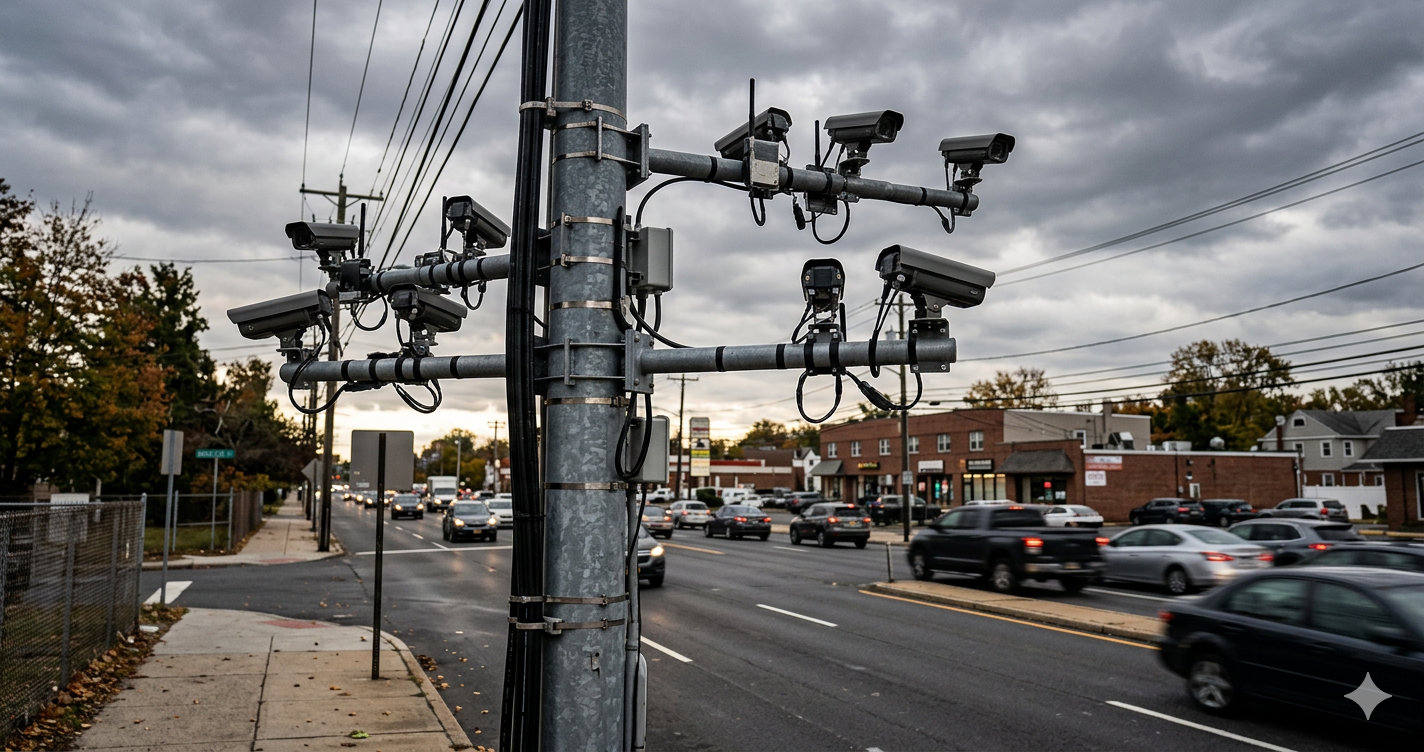
The Flock Safety camera system is best known for its network of automated license plate readers (ALPRs), along with other AI-enabled surveillance cameras. These devices are typically mounted on poles along public roads, at neighborhood entrances, or near businesses. As vehicles pass, the cameras automatically photograph license plates and log details such as the plate number, vehicle make, model, color, time, and location. Some systems also capture still images that provide additional identifying context.
The information collected is uploaded to a cloud-based database. Law enforcement agencies, and in some cases private customers like homeowners’ associations, can search that database to look for vehicles connected to crimes or investigations. Over the past decade, Flock has grown into one of the largest providers of ALPR technology in the United States, with its cameras used by thousands of agencies across most states.
How Widespread Is Its Use?
Flock’s expansion has been rapid. Today, its ALPR cameras are deployed by thousands of police departments and local agencies in nearly every U.S. state. Collectively, the system generates billions of license plate reads, creating a vast historical database that can be searched across jurisdictions. This means a vehicle spotted in one city can potentially be tracked through records captured in another.
Beyond traditional policing, Flock has also partnered with private neighborhoods and businesses seeking added security. At the same time, adoption has not been universal. Some municipalities have ended contracts or paused deployments amid growing public debate over privacy and oversight.
Benefits and Why Supporters Back It
Supporters, particularly in law enforcement, describe ALPR systems as practical investigative tools. When a vehicle connected to a carjacking, burglary, assault, or missing person case passes a camera, officers can receive near real-time alerts. This rapid identification can help police respond more quickly than relying on eyewitness accounts alone.
The technology can also map a suspect vehicle’s past movements, which is especially useful in investigations that cross city or state lines. Officers can compare license plate reads against hotlists, such as stolen vehicle databases or Amber Alerts, increasing the chances of recovery.
Flock has also promoted transparency features, including an online portal that allows the public to see aggregate data about how local agencies use the system and review audit logs. Company officials argue that built-in logging tools help track who searches the database and why.
Privacy Concerns and Potential for Misuse
Despite its investigative value, the system has drawn significant criticism from civil liberties groups and watchdog organizations.
One major concern involves data sharing with federal agencies. In Illinois, officials ordered an end to access by U.S. Customs and Border Protection after discovering that ALPR data had been shared in ways that violated state law. In response to similar controversies, Flock paused certain federal cooperation agreements and introduced keyword filters intended to block searches related to topics such as abortion or immigration. In Mountain View, California, police temporarily disabled Flock cameras after learning that federal agencies had accessed the data without proper authorization. These cases fueled broader debates about whether locally collected surveillance data should be searchable far beyond the community that gathered it.
There have also been documented cases of individual misuse. In Sedgwick, Kansas, a police chief reportedly used ALPR tools to track his ex-girlfriend’s vehicle hundreds of times. In nearby Kechi, Kansas, a lieutenant was accused of using the system to monitor a spouse. Investigations in multiple states have uncovered improper searches, including the use of racial slurs in database queries. In some instances, officers were suspended or fired. These cases highlight how powerful surveillance tools can be abused when oversight fails.
Cybersecurity has been another area of concern. Audits have found that some agencies failed to enable basic protections such as multi-factor authentication, potentially exposing sensitive systems to unauthorized access. In a separate incident, dozens of AI-enabled camera feeds were reportedly left accessible online without proper safeguards, raising questions about how securely surveillance footage is managed.
Civil liberties organizations such as the Electronic Frontier Foundation and the American Civil Liberties Union argue that large-scale ALPR databases create detailed records of people’s movements, often without a warrant. They warn that continuous vehicle tracking could chill lawful protest, religious attendance, or other constitutionally protected activities. Legal standards also vary widely from state to state, meaning protections in one jurisdiction may not apply once data is shared elsewhere. In Virginia, at least one court has ruled that long-term automated license plate tracking can constitute a search under the Fourth Amendment.
Balancing Safety and Rights
Flock Safety and its supporters maintain that the technology provides measurable public safety benefits, especially when paired with clear policies and transparency. Audit logs and data-retention rules are designed to limit abuse. However, critics argue that deployment has often outpaced regulation.
Advocates for stronger safeguards frequently call for strict limits on how long data can be stored, warrant requirements for historical searches, independent oversight, public reporting, and meaningful penalties for misuse. The central debate is not just whether the technology works, but how it should be governed.

Map of ALPR cameras in the Omaha Metro provided by https://deflock.org
Omaha, Nebraska, Expansion With Privacy Pushback
In Omaha, the Douglas County Sheriff's Office adopted Flock ALPR cameras after a trial period that officials said helped solve thefts, burglaries, and assaults more efficiently. Early deployments reportedly contributed to recovering stolen property and advancing investigations that might otherwise have stalled. The sheriff later signed a contract to continue operating roughly 25 cameras around the county, placing them on public roads to generate real-time alerts when a stolen or wanted vehicle is detected.
The rollout has sparked criticism from the ACLU of Nebraska, which argues that continuous scanning creates a searchable record of ordinary residents’ movements. Online discussions among Omaha residents reflect concern about what some call “silent surveillance,” even when drivers are not suspected of any wrongdoing.
Lincoln, Nebraska, Investigative Tool With Legal Safeguards
In Lincoln, located in Lancaster County, the Lincoln Police Department implemented ALPR technology, using cameras built by Axon, after a 2024 trial. During a seven-month test involving 19 cameras mounted on patrol vehicles, officers located a homicide suspect and recovered 30 stolen vehicles valued at approximately $179,000.
Lincoln’s program operates under the Nebraska Automatic License Plate Reader Act, which generally limits data retention to 180 days unless tied to an active investigation and requires public reporting. Department policy requires officers to verify alerts before taking enforcement action, and the city provides usage information through a public transparency portal. While these measures are intended to safeguard privacy, some residents and advocacy groups still question whether large-scale vehicle tracking is appropriate even with statutory limits in place.

Map of ALPR cameras in the Little Rock area provided by https://deflock.org
Little Rock, Arkansas, Expanding Surveillance Network
In Little Rock, city leaders have considered expanding their network of license plate readers in partnership with Little Rock Police Department and Flock Safety as part of a broader real-time crime center initiative. A 2025 proposal called for purchasing about 30 additional cameras to add to roughly 75 already in operation, potentially bringing the total to more than 100 citywide.
Some of the funding has come from federal pandemic-recovery dollars, prompting discussion about both costs and oversight. Civil liberties advocates, including the ACLU, have urged city officials to consider alternatives that do not connect to large national surveillance networks. Meanwhile, local residents have debated whether the cameras primarily help with Amber Alerts and stolen vehicle recovery or represent continuous location tracking of everyday drivers.
What This Means for Residents
Across Omaha, Lincoln, and Little Rock, law enforcement officials defend ALPR systems as tools that improve response times and help recover stolen vehicles and locate suspects. Legal frameworks such as Nebraska’s ALPR law are designed to limit data retention and require transparency. Yet privacy advocates argue that even regulated systems accumulate sensitive location data on people who are not suspected of crimes, and that rules governing access and sharing remain inconsistent nationwide.
These cities illustrate the broader national debate: how to harness technology that can assist investigations while ensuring it does not quietly expand into a system of routine mass surveillance.